
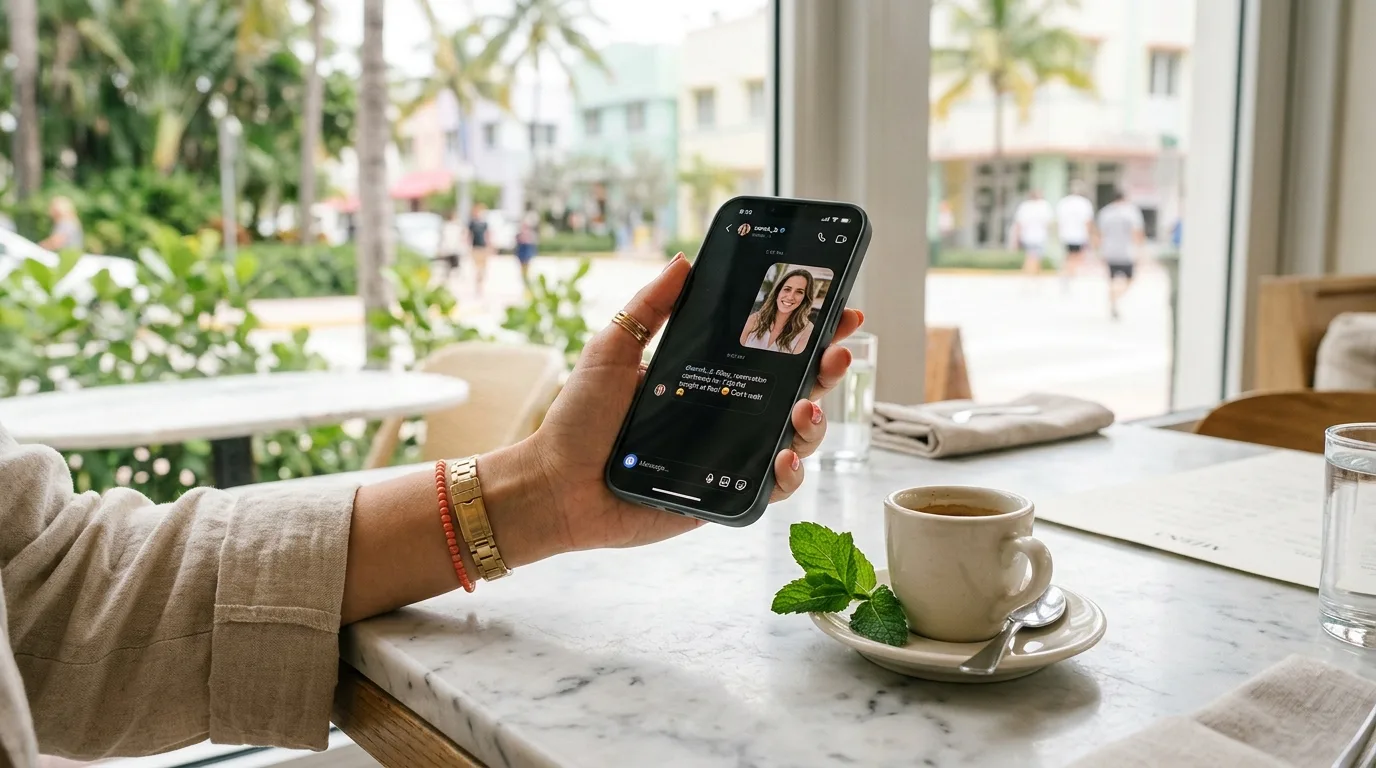
The booking came in at 1:47 a.m. on a Tuesday. A four-top, Friday at 8, a quiet birthday request for the corner banquette. The hostess was asleep. The owner was asleep. The Instagram DM was open and a small green dot answered for them.
That message lives on a real Wynwood restaurant we worked with last spring. It is also the cheapest thing they shipped all year. The chatbot cost less than a single shift and it now books, confirms, and reminds about 11 percent of their weekly covers without a human touching the conversation.
This is what an AI chatbot for a Miami restaurant actually looks like in 2026. Not a futuristic gimmick. Not a Silicon Valley pilot. A small tool that closes the gap between when your guests want to book and when your team is awake.
In this post we walk through what these bots really do, where they pay off in Miami specifically, how to set one up without breaking your existing systems, and how to know when it makes sense to skip it. If you want help building one, our AI chatbot service is built for exactly this kind of restaurant use case.
What an AI Chatbot Really Does for a Restaurant
A restaurant chatbot is not one thing. It is a stack of small conversations the bot can handle without you. The four jobs that matter most in Miami are reservations, menu questions, special requests, and ordering or catering inquiries. Everything else is a nice-to-have.
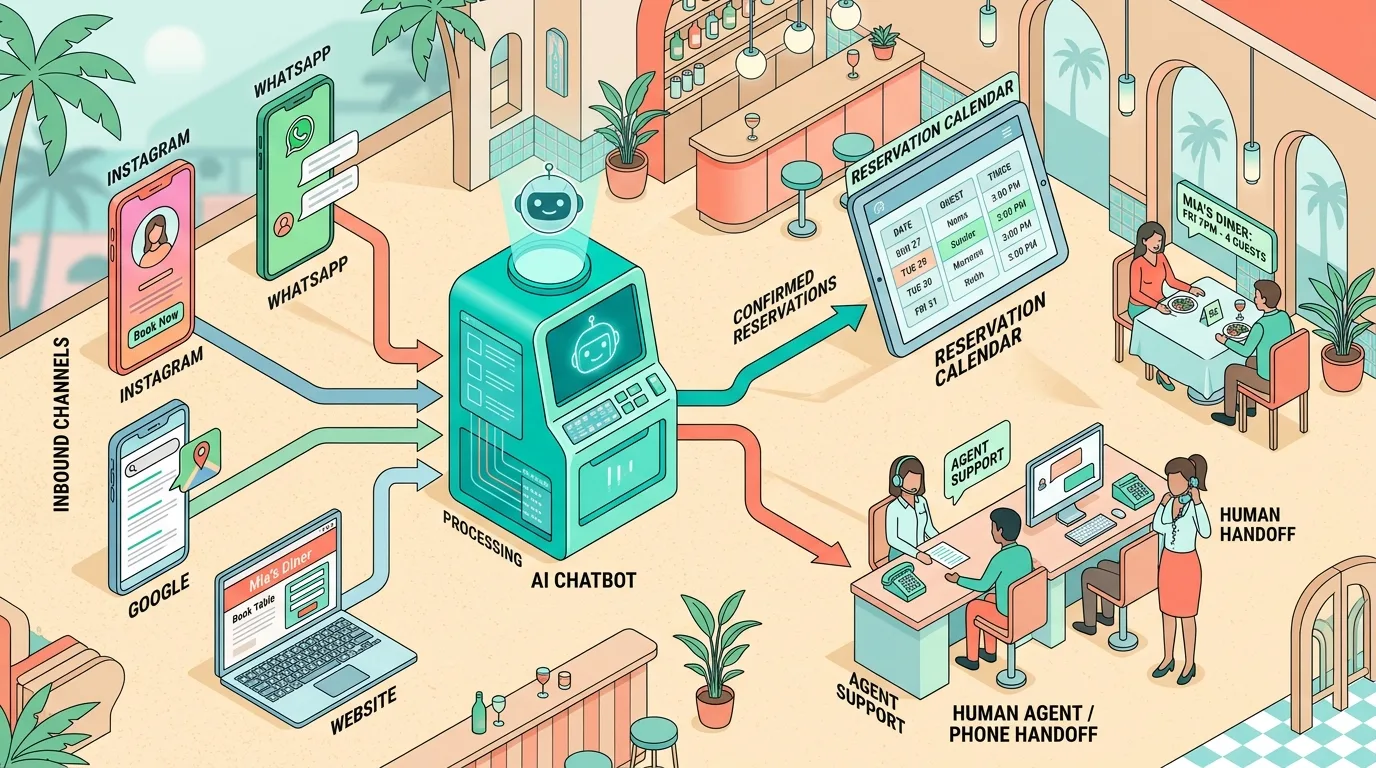
A good bot answers in the channel where the guest already is. That is almost never your website chat widget. In our Miami client work, the channels that drive volume are Instagram DMs, WhatsApp, Google Business Profile messages, and SMS, in that order. A high-end Brickell steakhouse will see most inquiries through Google. A Calle Ocho ventanita will see them through WhatsApp. The same bot can sit behind all of them.
The bot does five things the moment a message lands. It reads the request, classifies the intent (book, ask, complain, order), pulls live availability from your reservation system or menu source, drafts a clear reply in the right language, and either books the table or hands the conversation to a human with full context. The handoff matters. Bots fail the moment they hide a frustrated guest from your team.
You do not need a large language model with the memory of a librarian to do this well. You need a small, well-trained agent with access to your reservation system, your menu, your hours, and one clear escalation rule. We usually pair an off-the-shelf voice and chat platform with a custom integration layer so the bot knows your restaurant, not just any restaurant. Our AI agents service covers the heavier voice work for restaurants that take a lot of phone calls.
Why Miami Restaurants Win With Chatbots Faster Than Most
Miami is unusual. The booking patterns are not the same as Nashville or Austin. We see four local realities that make chatbots pay off quickly here.
The first is the bilingual reality. Half the inquiries a Little Havana or Hialeah restaurant gets come in Spanish. A bot that speaks both without forcing the guest to switch wins by default. We have watched response rates climb 30 to 40 percent on Spanish DMs once the bot starts replying in Spanish, in Miami Spanish, not Madrid Spanish.
The second is tourist seasonality. From November through April, snowbird and tourist traffic swings volume in ways your hostess team cannot staff for. A bot can absorb the surge. When the lobby fills, the chatbot handles the inbound while your team handles the room.
The third is the late-night culture. Miami people book late. They DM at 1 a.m. about brunch on Saturday. They Insta-stalk your menu while in line at LIV. If you reply at 11 a.m. the next day, half of them are already booked somewhere else. A bot that answers in under a minute is the difference between a saved cover and a lost one.
The fourth is the event-driven nature of the city. Art Basel, Ultra, Formula One, every cruise turnaround weekend, every Heat playoff run. Demand pulses. A chatbot can be configured for surge handling: longer waitlists, priority for repeat guests, automatic deposit collection for prime time slots. Try doing that manually on a Heat playoff Saturday.
A Working Setup, Stage by Stage
Here is the actual rollout we use for a Miami restaurant client. Total time, about two weeks, mostly waiting for menu and reservation data to be cleaned.
- Audit the inbox. We pull the last 90 days of messages from Instagram, WhatsApp, GBP, and the site form. We tag each one by intent. Usually 60 to 75 percent are reservations, menu questions, or hours. That is the first batch the bot needs to handle.
- Pick the channels. Most Miami restaurants start with Instagram DMs and Google Business Profile, then add WhatsApp once the reservation flow is working. Website chat usually goes last because volume is low.
- Connect the data. The bot needs three live sources: the reservation system (OpenTable, Resy, SevenRooms, Tock), the menu, and the hours. We avoid scraping. We use APIs or a clean shared sheet, so when you change a special the bot knows by lunch.
- Write the voice. This is where most off-the-shelf bots fail. We write the personality, the greeting, the apology, the upsell line, the way it asks for a phone number. It should sound like your restaurant, not a help desk.
- Set the escalation rule. Any complaint, any allergy mention, any group of eight or more, any press question, any modification to an existing reservation goes straight to a human with the full chat thread attached.
- Pilot for two weeks. We watch every conversation. We tune the prompts. We add the questions the bot did not know how to answer. By day 14, the resolution rate is usually past 70 percent.
- Measure and report. We track first response time, resolution rate, booked covers, abandoned chats, escalations, and language split. A weekly digest goes to the owner. Anything that drops gets fixed that week.
If you want to skip the trial-and-error, see our pricing for a chatbot build and we will scope it for your specific stack.
Where AI Chatbots Quietly Fail
We have also seen these projects go badly. Three patterns show up every time.
The first is the bot that never escalates. The owner sets a high confidence threshold and the bot keeps trying to handle messages it should hand off. A guest with an allergy gets a chirpy generic reply. A reporter asking about a health-code rumor gets a polite "we are closed for the night." Both of those are reputation hits. Always tune the handoff rule before you tune for resolution rate.
The second is the bot trained on a stale menu. If your kitchen changes specials twice a week and your bot is still recommending the duck from October, you lose trust fast. Either connect the bot to a live source or commit to a weekly menu refresh. There is no third option.
The third is the bot that lives in a different system from your team. Hostesses cannot see the bot's chats. Managers do not get notified when escalations come in. The bot becomes an island. Pick a setup that puts the conversations into a shared inbox the floor team already uses. Most modern CRMs handle this, and the ones that do not should not be in the running.
A smaller failure mode worth naming: the bot that talks like a corporate help center. "I appreciate your inquiry. I will be happy to assist you." That sentence will not sell a single tasting menu in Miami. Write the voice like your best server would write it.
What the ROI Math Actually Looks Like
We do not want to be vague here. Below is the real shape of the numbers from three Miami restaurant clients across the last twelve months. Names are out. The math is honest.
| Metric | Casual Brickell spot | Wynwood neighborhood restaurant | High-end Coral Gables dining |
|---|---|---|---|
| Monthly inbound messages | 900 | 1,400 | 550 |
| % handled fully by bot | 68% | 74% | 61% |
| Avg first response time, before | 4h 12m | 3h 41m | 2h 09m |
| Avg first response time, after | 52s | 48s | 61s |
| Booked covers attributed to bot | 84 | 161 | 47 |
| Net monthly revenue impact | ~$3,900 | ~$7,800 | ~$5,200 |
| Total monthly cost | $590 | $780 | $640 |
A few honest caveats. The Wynwood spot already had heavy Instagram volume, which is why the bot earns out faster there. The Coral Gables restaurant runs a higher average ticket, which is why fewer bookings still drive solid revenue. The Brickell number is the slowest payback of the three because their existing team was already pretty fast on DMs. Even the slowest case earns out about six times.
These are not promises. They are what we have seen. A bot that does not match your guests, your menu cadence, and your channels will not produce these numbers.
Build vs Buy, the Honest Version
Off-the-shelf tools work for the simplest restaurants. If you have a single location, one reservation system, and a menu that does not change much, a tool like Popmenu, Slang AI, or a templated ManyChat flow can carry you a long way for a low monthly fee.
The moment you have multiple locations, a catering arm, multilingual demand, a CRM you actually use, or a real loyalty program, the off-the-shelf options start to crack. We move clients to a custom build at that point: usually a small agent layered on top of a chat platform, with custom integrations into the reservation system, the CRM, and your POS for catering quotes.
The right answer for most Miami restaurants is to start with a smart off-the-shelf setup, run it for 90 days, and only graduate to custom when the data tells you the templates are leaving covers on the table. Our portfolio has examples of both paths.
The One Thing to Do Tomorrow
Open your Instagram inbox. Scroll through the last 30 unread messages. Tag each one as reservation, menu question, complaint, or other. If more than half are reservations or menu questions, a chatbot will pay for itself in a quarter. If they are mostly complaints or media questions, fix the underlying issue first, then build the bot.
When you are ready to scope one, start a project with us. We will look at your channels, your reservation stack, and your busiest hour, and tell you honestly whether a chatbot belongs in your next 90 days or not.