

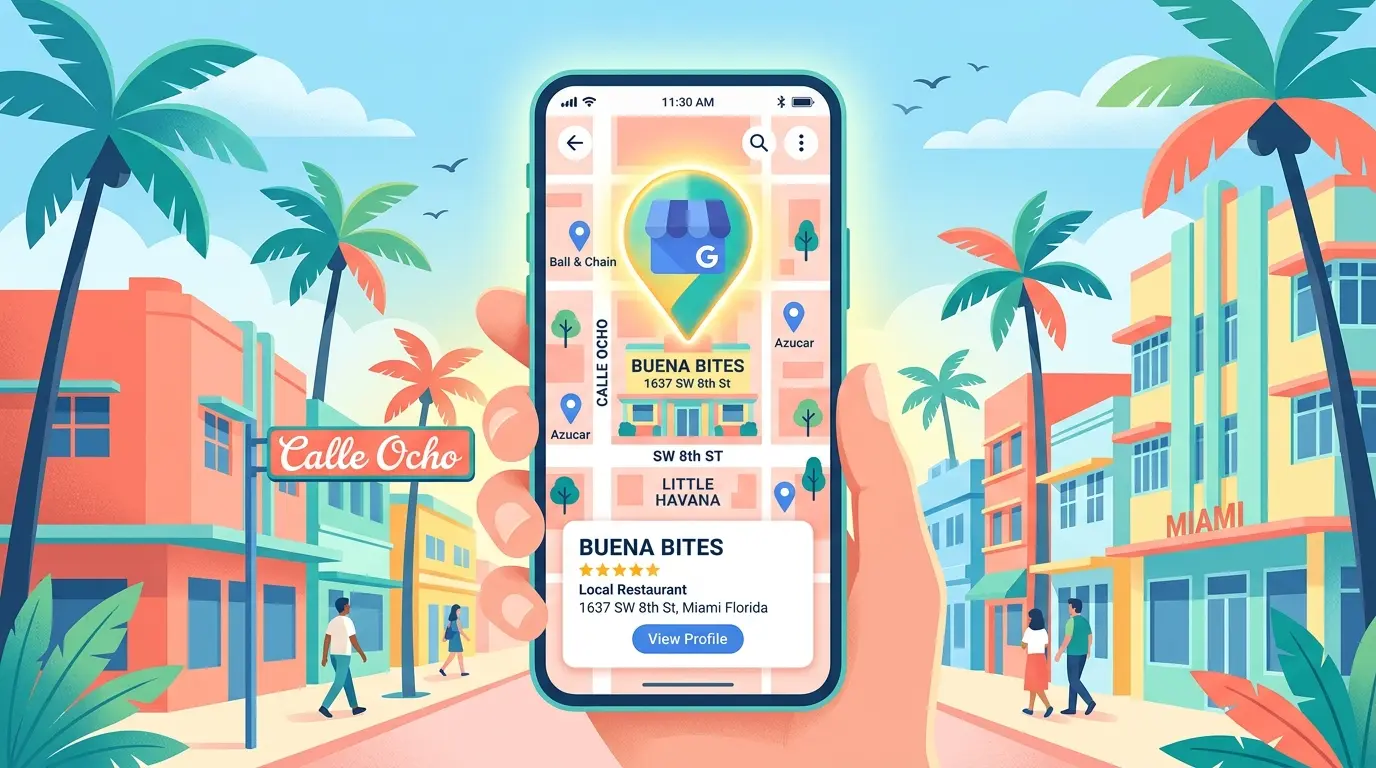
A Brickell law firm we audited last month had a Google Business Profile with the wrong office number, no photos newer than 2022, and a primary category set to "Legal Services" instead of "Personal Injury Attorney." They were paying an agency $2,200 a month for SEO. The map pack rank for their core query was 14. Two weeks of GBP cleanup later, with no other changes, they were sitting at four.
This is the boring truth about Google Business Profile optimization in 2026. Most Miami businesses are losing rankings to the agency next door not because the agency is more clever, but because the agency keeps the profile clean. That is it.
This post is the checklist we run for every Miami client we onboard. Twenty-eight items, organized into four phases, with the bilingual tip almost nobody runs and the photo strategy we use to push the map pack in this city specifically. If you want us to run it for you, our Google Business Profile service is built around this exact checklist.
A note before we start. This works for single-location Miami businesses and multi-location brands. It works for storefronts and for service-area businesses. It does not work if your business does not actually exist at the address you list or in the service area you claim. Google catches that quickly in 2026.
Phase One: Foundation (Days 1 to 7)
Most of what wins the map pack lives here. Skip this and the rest of the work compounds slowly or not at all.
- Verify ownership. If you do not own the profile, claim it. Google offers phone, postcard, video, and in some cases live-call verification. Pick whichever fits your business and complete it before you do anything else.
- Confirm the primary category, then confirm again. This is the single most important field on the profile. A "med spa" should not be set to "Spa." A "personal injury lawyer" should not be set to "Law Firm." The primary category controls which queries Google considers you for. Use a tool like GMBcrush or PlePer to see exactly which category your top three competitors use, and pick the one that matches your dominant service.
- Add 3 to 5 secondary categories. Be honest. A med spa might add "Skin Care Clinic," "Medical Spa," and "Beauty Salon" if those services exist on site. Do not add categories for services you do not actually offer. Google has gotten good at catching this.
- Lock the NAP. Name, address, phone, exactly as they appear on your website footer and across the top 50 directories. If you have ever had a different phone number, suite number, or DBA, hunt those down.
- Set service area or storefront correctly. Storefronts with walk-in traffic show an address. Service-area businesses (mobile, in-home, or delivery) hide the address and set a clearly defined service area. Mixing the two confuses Google and customers.
- Hours, including holidays. Set regular hours, special hours for Memorial Day, July 4, Labor Day, Thanksgiving, Christmas, and New Year's, plus any local closures (we put hurricane prep days here for service businesses).
- Phone number that a human answers. A vanity number that rings to voicemail kills conversion. Use the line a real person picks up.
By day 7 your profile is structurally clean. You will not see ranking changes yet. That is fine.
Phase Two: Content That Earns Trust (Days 8 to 21)
The next two weeks are about giving Google and customers reasons to trust the profile.
- Write the business description. 750 characters. Put the primary keyword in the first sentence, written for a human. Mention the neighborhood. Mention the languages you serve. Do not stuff.
- Upload at least 30 photos, with a real Miami strategy. This is where most local guides give weak advice. Here is what works in Miami specifically:
- 1 logo (square, white or transparent background)
- 1 cover photo (landscape, your storefront or signature shot)
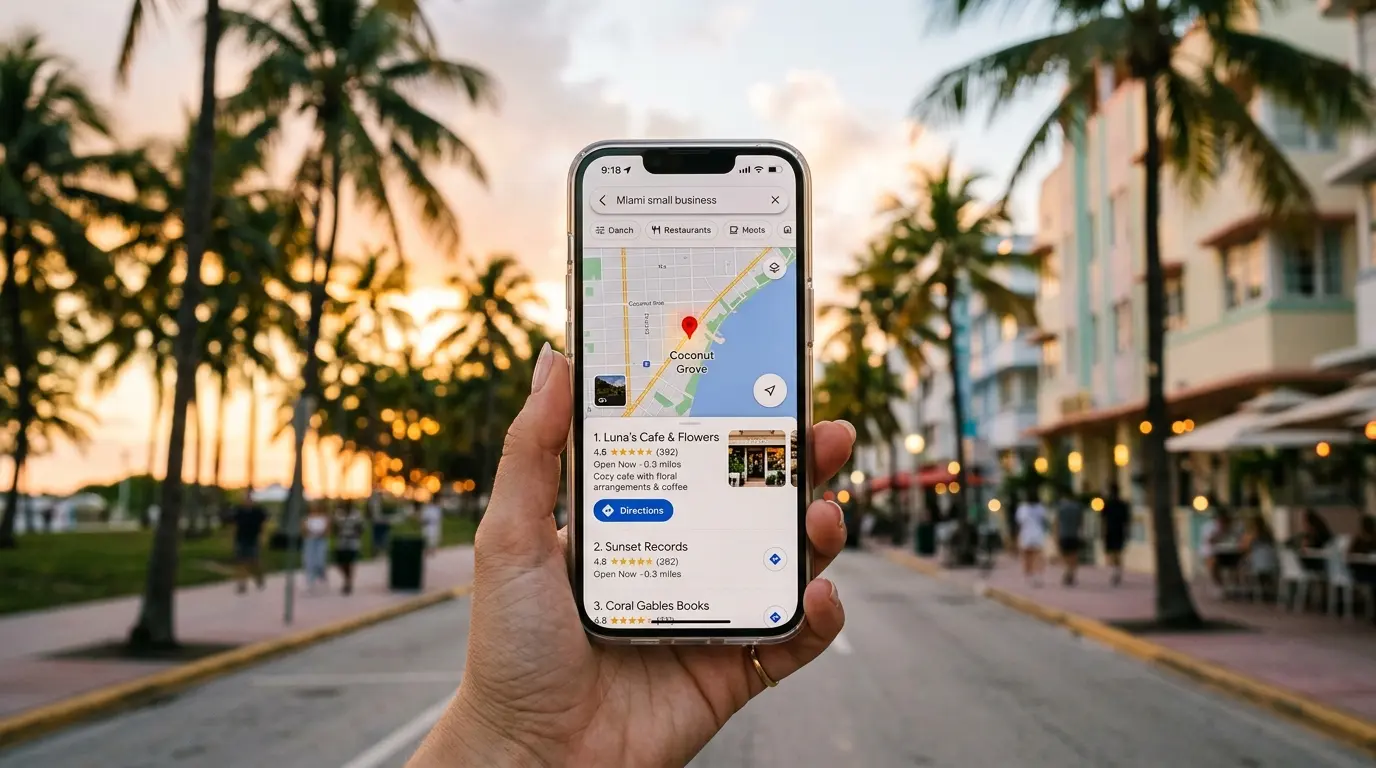
- 6 to 10 exterior shots (different angles, different times of day, including a sunny late-afternoon shot, this is your map pack thumbnail)
- 8 to 12 interior shots (wide angles, no people you do not have signed releases from)
- 4 to 6 team shots (genuine, not stock)
- 4 to 6 product or service shots
- 1 to 2 community shots (Wynwood mural, Brickell skyline, the local park, whatever ties you to place)
- Geo-tag the photos. Use a tool like GeoImgr or Photo Investigator to add EXIF data with your business coordinates. Google does not officially confirm this helps, but every local SEO test we have run over three years has shown a lift.
- Add services with descriptions. Each service gets a 200 to 300 character description with the keyword and the price (or a price range) if you can. Empty service tabs cost you visibility for the long-tail queries that actually convert.
- Add products if relevant. For retail, this is non-optional. For service businesses, treat it as a bonus rank signal.
- Set attributes honestly. "Wheelchair accessible," "free wifi," "outdoor seating," "owned by Latina." If it is true, set it. Half of these surface in search filters.
- Add Q&A entries yourself. Pre-populate the top 6 to 10 questions your business gets, with your own answers. If you do not, random customers will, and the answers will not be the ones you want.
Phase Three: The Bilingual Move (Days 22 to 35)
This is the one most Miami GBP guides skip. It moves rankings here in a way it does not in monolingual markets.
- Translate the business description into Spanish, but do not just translate. Write a Spanish-first version that sounds like your business in Spanish. Add it to the description as a second paragraph (Google does not officially support separate language fields for the description, so we run them together).
- Reply to Spanish reviews in Spanish. Mirror the language of the reviewer in every reply. Google's system reads language signals on responses, and customers feel the difference immediately.
- Post Google Business Profile posts in both languages. Alternate weeks, or run two posts per week, one in each language. Use the same offer or update, translated.
- Tag photos with bilingual filenames before upload. "doral-warehouse-exterior.webp" pairs with "almacen-doral-exterior.webp." Small signal, real lift over time.
- Confirm the GBP language setting matches your dominant market. Many Miami profiles default to English even when 70 percent of inquiries come in Spanish. Update it in the Google Business Profile manager.
Spanish-language audiences in Miami are not a niche. For most South Florida businesses, ignoring this move costs you a meaningful chunk of the local map pack visibility you are already paying to chase.
Phase Four: The Ongoing Cadence (Day 36 Onward)
Optimization without a cadence dies. These are the recurring habits that hold the rank you earned.
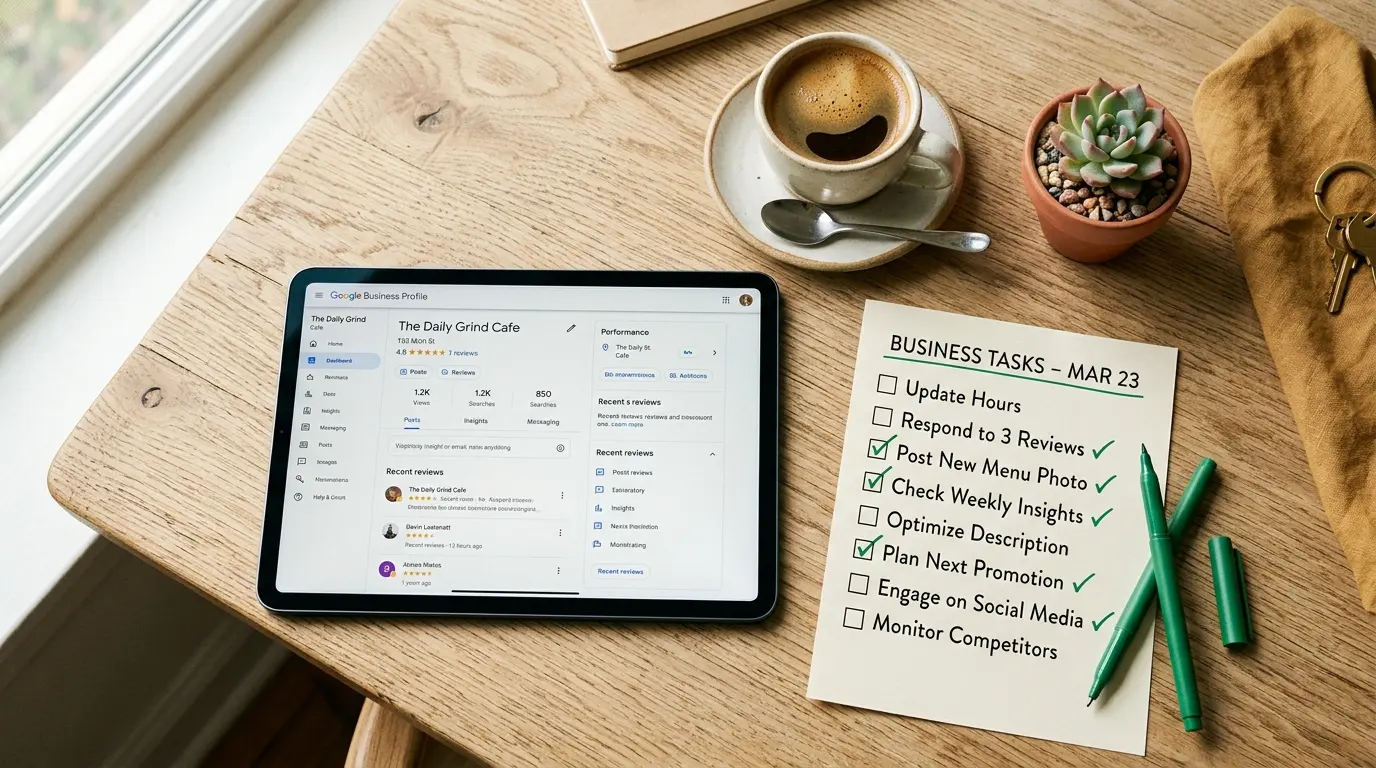
- Two GBP posts per week, every week. Mix three post types: offer or service, behind-the-scenes or event, customer story or result. Each post is two or three sentences plus a CTA.
- One review request per business day. Send the direct review link by text or email at the moment of delight. Personalize the ask. Mirror the customer's language. Track the conversion rate by channel.
- Reply to every review within 48 hours. Positive or negative. Use the customer's name. Mention something specific. Avoid templates. Google reads these.
- Upload 4 to 6 new photos per month. Fresh photos signal an active profile. Take them on a phone, the quality is fine.
- Update services or products quarterly. New offering, price change, seasonal addition. Update the profile within a week.
- Audit categories every six months. Google adds new GBP categories regularly. The category that was right in January may not be the best one in July.
- Monitor the Q&A weekly. Answer new questions within 24 hours. Flag and report inappropriate ones.
- Track competitor changes monthly. If three local competitors all add a new secondary category, that is a signal.
- Run the full audit annually. Top to bottom. Treat the profile like a microsite that earns you customers.
If you want a second pair of eyes on your current setup, our local SEO service starts with a free GBP audit using exactly this checklist.
What Will Not Work in 2026
A few things we keep getting asked about that we no longer recommend.
Keyword-stuffing the business name. Adding "best" or "Miami" or "near me" to the legal business name violates Google's guidelines and gets profiles suspended. We have seen it happen to clients who came to us from previous agencies. The recovery process takes months.
Buying reviews. Google's review filter caught up in 2024 and now removes patterns of paid or incentivized reviews aggressively. Worse, accumulating fake reviews now triggers a quality flag that can hide the profile from the map pack entirely.
Embed-only optimization. Adding a Google Maps embed to your website does not optimize your profile. It is a nice trust signal but it does not move ranking.
Service area inflation. Listing a 50-mile radius around your single Doral location to try to rank in Aventura, Hialeah, Pinecrest, and the Beach does not work and triggers spam flags. Set the radius you actually serve.
What Replaces Those Tactics
Three things that do work in 2026 and that most Miami competitors are still ignoring.
Neighborhood landing pages on your website that link to and reference your GBP. A page for each neighborhood you serve, with real local content, internal links, and embedded GBP. This is the single highest-value on-site move for local rank in 2026.
A regular cadence of in-language Google posts and review replies. Boring. Effective.
Real photo refreshes with current dates. Old photos signal an inactive business. New photos signal a live one. Google ranks live businesses higher in the map pack.
The One Thing to Do Tomorrow
Open your GBP in incognito. Write down every single field that is wrong, outdated, or empty. Categories, hours, phone, photos older than a year, missing services, empty Q&A. Fix all of it before Friday.
When you want help running the full 28-item checklist, start a project with us and we will scope the work for your specific market and category. If you want to keep running it yourself, our SEO playbook walks through the broader local SEO work that pairs with this checklist.