



The Aventura clothing brand had hired three Miami web design agencies before they called us. The first one ghosted after the deposit. The second delivered a site that looked nothing like the proposal. The third built something beautiful that crashed under traffic the day they launched a promo. By the time they sat in our conference room, the founder had stopped trusting agencies entirely.
We get versions of this story every quarter. Miami has hundreds of web design agencies, freelancers, and "marketing firms" that offer websites as a side dish. Some are excellent. Some are a slow drain on your bank account. The hard part is telling the difference before you sign.
This post is the agency-side version of the hiring guide. We are a Miami web design agency, and we are going to tell you exactly what to ask, what to demand, and what to walk away from, including questions that will pressure-test us as easily as anyone else. If you want to see how we describe our own work upfront, start with our website design service page and bring these questions to any call.
A note on context. This guide is written for businesses spending between $5,000 and $35,000 on a website. Below that, you are usually in templated or DIY territory. Above that, you are in enterprise procurement and a blog post will not save you. Use a proper RFP.

The Ten Questions That Predict the Outcome
We have run hundreds of discovery calls on both sides of the table. These ten questions consistently separate the agencies that ship from the ones that disappoint. Bring them to every call.
- Can you name three Miami clients you launched in the last 12 months, and may we contact them? A real agency will name names and connect you. A shaky one will offer "references on request" that never materialize. Ask the references about timeline, budget, and communication. Not about whether they liked the site.
- Who specifically will work on my project, and what is their experience? You want the senior designer's portfolio, the developer's GitHub or code samples, and the project manager's name. "Our team" is not a person. Get names.
- Walk me through your discovery process in detail. A real process has stages, deliverables, and timing. If the answer is "we have a kickoff call and then we get to work," you are buying a templated build dressed up as a custom one.
- What does the proposal scope cover, line by line? Page count, template count (these are different), revision rounds, copy support, image sourcing, hosting setup, training, post-launch support. Demand line items.
- What is your timeline, and what kills it? A real answer names client delays as the biggest risk and explains what you owe the agency, by when, to keep the schedule.
- What technology stack do you build on, and why for my business? WordPress, Webflow, Shopify, Nuxt, Next, custom. Each has trade-offs. The agency should explain why their stack fits your business specifically, not just why they prefer it.
- How will you measure whether the project succeeded? Speed scores, accessibility benchmarks, conversion lift, organic ranking, qualified leads. Pick at least two specific metrics with target numbers before you sign.
- What happens at the end of the project? Do you own the files, the domain, the hosting account, the CMS access? Get this in writing. We have rebuilt sites for Miami clients who could not get their own logo files back from their previous agency.
- What does support look like after launch? Hourly retainer, monthly maintenance, ad hoc, none. Each is a valid model. Hidden support fees are not.
- What do you not do well? This is the cheat code. A confident agency will tell you honestly. We do not do enterprise commerce. We do not do ad-heavy programmatic landing pages at volume. We do not do brand-from-scratch for businesses that have not done their positioning work. If an agency says "we do it all," they probably do not do any of it especially well.
If you want a benchmark, run these questions on our team too. Browse our recent project work first so the references and questions land in context.
Six Red Flags That Mean Walk Away
Across the Miami market, six warning signs come up repeatedly. Any one of these is enough to end the conversation.
The first is a demand for 100 percent payment upfront. Industry standard is a deposit between 30 and 50 percent with milestone payments tied to deliverables. Full payment upfront removes every incentive to finish on time.
The second is a proposal without a scope document. A scope of work shorter than three pages on a $10,000-plus project is a tell. Scope creep will eat your budget and your patience.
The third is a portfolio that mostly looks the same. Most Miami agencies have a "look." That is fine. But if every site in the portfolio uses the same template with a different logo, the agency is selling you template work at custom prices.
The fourth is a refusal to share references. Some agencies cite NDAs. Most NDAs cover the work, not the client relationship. A vague "we cannot share" is usually a polite "we cannot deliver."
The fifth is an agency that pivots languages or sales reps every meeting. Continuity matters. If the person you signed with disappears after the deposit clears, the work usually disappears too.
The sixth is an agency that talks about themselves more than you on the discovery call. A good discovery call is 70 percent the agency asking smart questions and 30 percent the agency answering yours. A bad one is the inverse.
What to Demand in the Contract
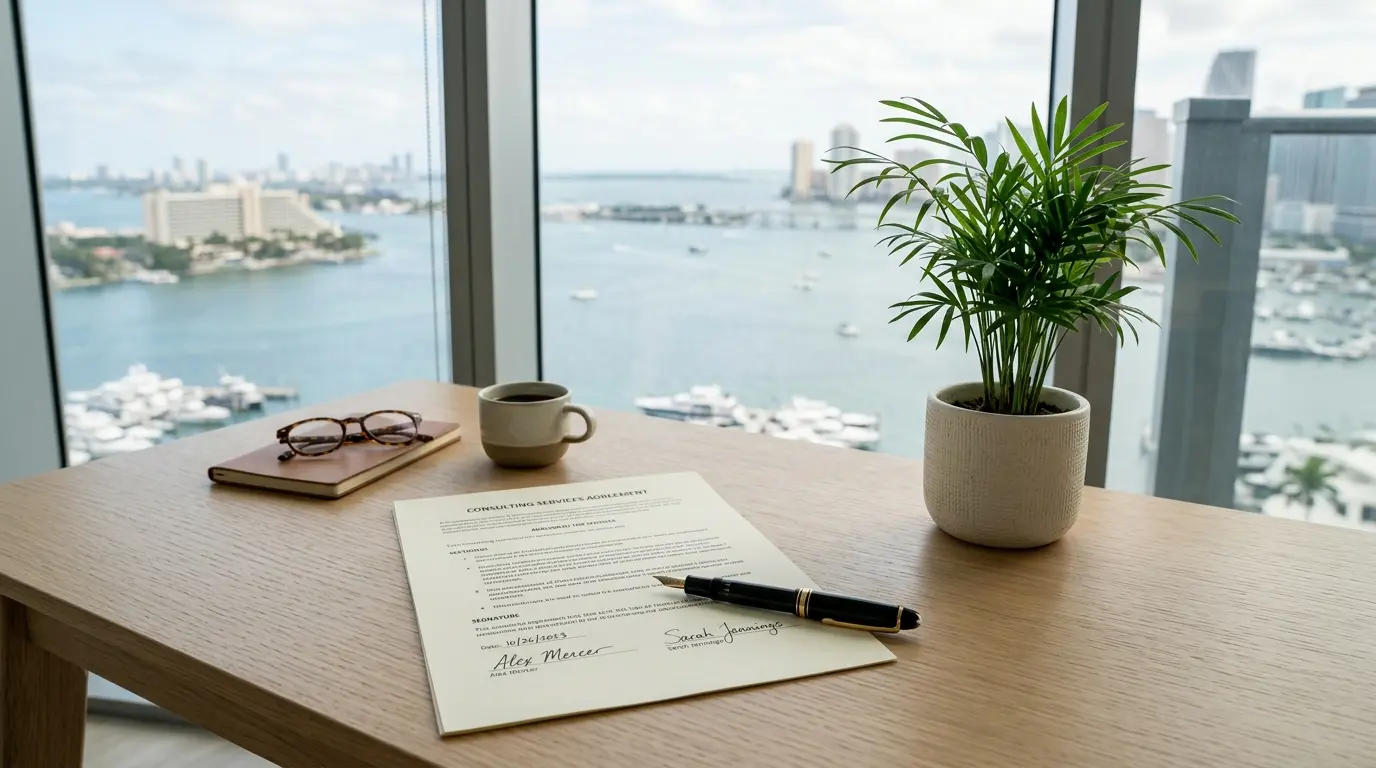
The proposal is the sales document. The contract is what survives. Three contract clauses will save you more than any negotiation tactic.
Milestone payments tied to specific deliverables. Not calendar dates. Not phase names. Specific deliverables. "Deposit on signing. 30 percent on approved homepage design. 30 percent on developed site staged for review. Balance on launch." This aligns incentives.
A clean termination clause. What happens if you need to end the engagement? You should be able to terminate for cause with notice, recover all assets created to date (designs, code, content, accounts), and pay only for work completed. Agencies that resist this are the ones you need it from.
Asset ownership on launch. All design files, all source code, all written content, all domain and hosting accounts transferred to you on final payment. This should be one paragraph, in plain language. If it is missing or written in fog, push back.
A bonus clause many Miami businesses skip: a performance benchmark. Lighthouse 90+ on mobile, WCAG 2.1 AA pass, all critical pages under 2 seconds on a 4G connection, all key user flows tested. Tie the final payment to these passing. We require this with every project on our side. So should every client.
How to Evaluate Three Proposals Side by Side
You get three proposals. The numbers are wildly different. Now what.
Build a simple scoring table with the same five questions for each agency. We use:
- Total cost including stated maintenance for year one.
- Number of senior team members assigned to the project (not total team size).
- Number of unique custom templates in the scope.
- Timeline from signed contract to launch.
- References successfully reached.
Score each agency one to five on each row. The proposal with the lowest total dollar number rarely wins. The proposal with the highest senior staffing, most realistic timeline, and verified references almost always does.
Beware the middle proposal. There is a common pattern where three agencies quote roughly $4,000, $12,000, and $28,000 for the same scope. The instinct is to pick the middle one because it feels safe. The middle one is sometimes the right pick, but more often the cheap one is templated and the middle one is templated with extra polish. The expensive one might be the only real custom build in the group. Compare scope, not price tier.
Why a Miami-Based Agency Matters (and When It Does Not)
We are biased. Hire a Miami-based agency when your business is rooted here and your audience is rooted here. A Brickell law firm, a Wynwood restaurant, a Doral logistics company, a Coral Gables med spa. Local agencies understand the bilingual reality, the seasonal rhythms, the design literacy of the market, and the neighborhood-level SEO opportunities. They can meet you in person when something matters enough to be face to face.
That said, a Miami address is not a guarantee of quality and a non-Miami address is not a deal-breaker. We have seen excellent work from agencies in Atlanta, Austin, Mexico City, and Barcelona that served Miami clients well. The deciding factors are responsiveness, communication, and verifiable quality, not the zip code on the invoice.
Where a Miami agency wins clearly is on Spanish-language work for Spanish-speaking audiences, on local SEO for the South Florida map pack, and on builds that need to feel like Miami. Where it is neutral is on most general business work. Use the geography as one factor in your decision, not the only one.
If you want a sense of how we work and the kind of clients we serve, our about page is the best place to start before any first call.

The One Thing to Do Tomorrow
Pull the proposals you have received and run the ten questions in order. Email each agency the questions you have not asked yet. The agencies that respond fast and specifically are the shortlist. The agencies that respond slowly or vaguely are the answer.
When you want to put the questions to us, start a project with us. We will answer all ten on the first call, share three references in the first 24 hours, and tell you honestly whether we are the right Miami web design agency for your project or whether we are not.