


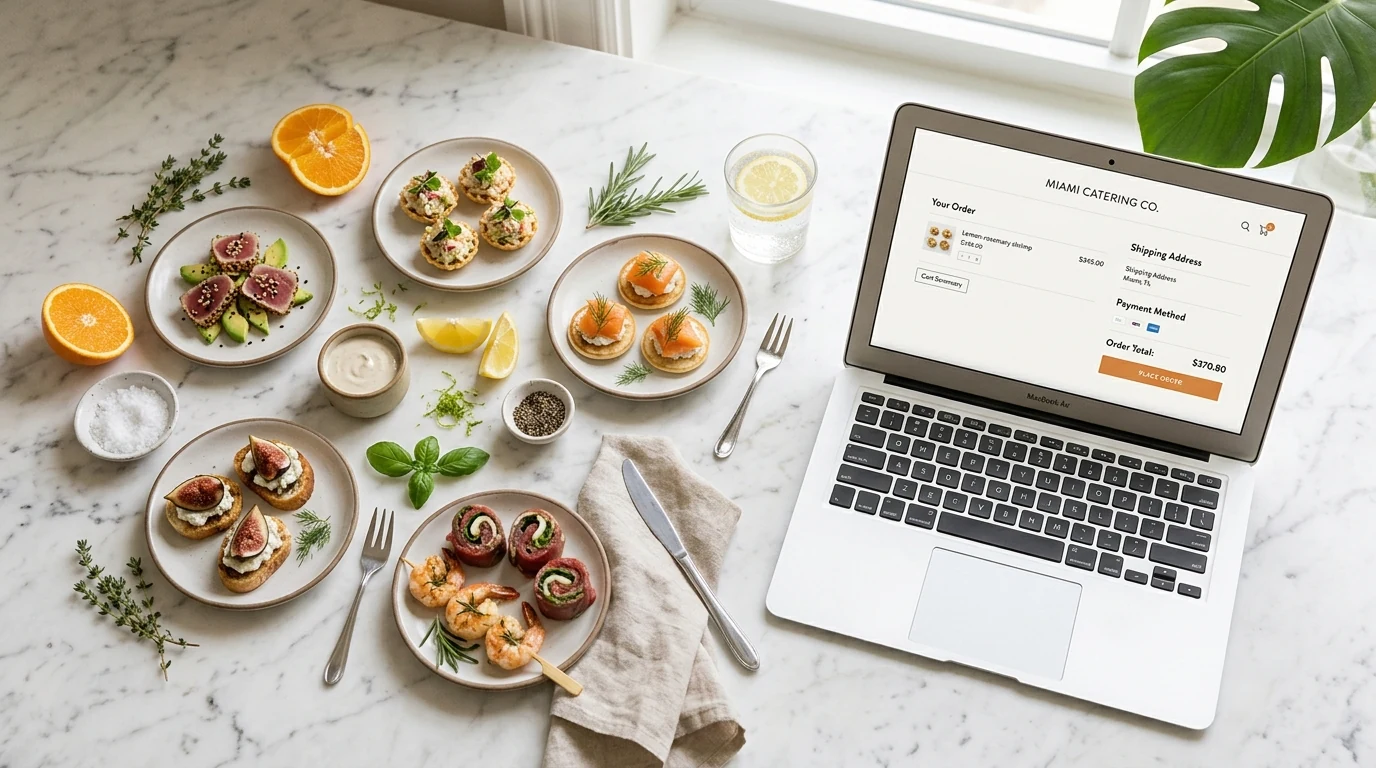
Dinner Is Served is a Miami private chef and catering brand that came to us with a Shopify template, a beautiful Instagram feed, and a checkout that converted 0.8 percent of visitors. The food was extraordinary. The website was politely losing them money. Every metric they cared about was flat.
We rebuilt the store in eight weeks. Conversion climbed from 0.8 percent to 3.4 percent. Average order value climbed 22 percent. Repeat purchases doubled. Nothing about the food or the reputation changed. The website stopped being the bottleneck.
This post is the four lessons we now bake into every Miami ecommerce build because of what we learned on that project. If you want us on your build, our website design service covers this kind of hospitality-adjacent ecommerce work.
A note on scope. This is written for Miami businesses running ecommerce that intersects service (catering, meal kits, personal shopping, private events) or high-consideration products (fine jewelry, art, furniture, wellness). Straight retail ecommerce shares some of these lessons but not all.
Lesson 1: The Checkout Flow Is Not the Standard Ecommerce Flow
Standard ecommerce checkout assumes the shopper knows what they want, adds it to a cart, enters a shipping address, and pays. That flow works for a T-shirt. It falls apart for a Miami catering order.
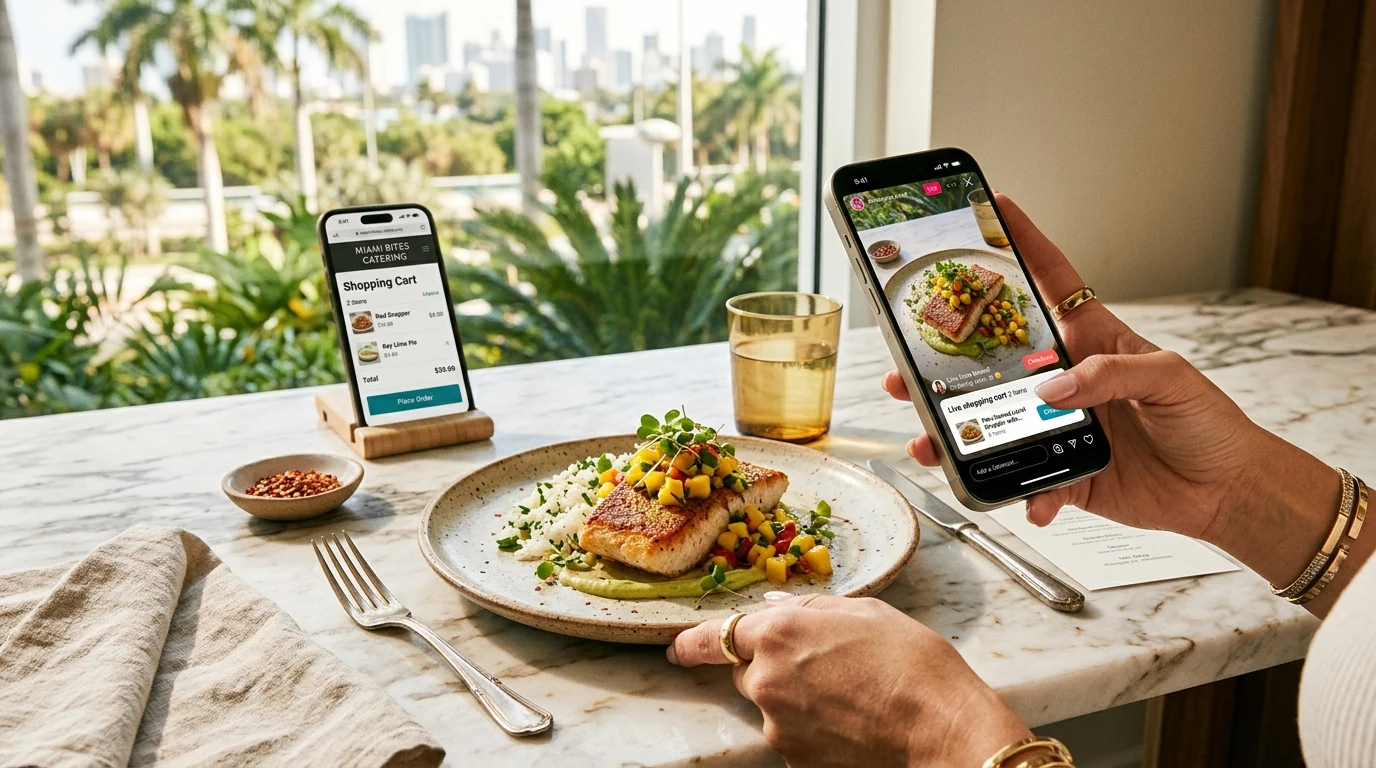
The Dinner Is Served checkout had to answer six questions before it could take payment. Date of the event. Number of guests. Type of service (drop-off, staffed, chef-attended). Dietary restrictions. Delivery neighborhood. Any allergies. Standard Shopify checkout has fields for none of these, and the workarounds we found online forced customers through five separate screens before they could pay.
The fix was a custom-built booking flow layered on top of Shopify. A single screen with progressive disclosure: date first, guests second, service type third, and only then the menu selection. The product catalog updated based on the answers (a Tuesday dinner for six shows different options than a Saturday event for forty). Payment came last, with a clear line about deposit versus balance due.
Cart abandonment dropped from 76 percent to 41 percent. The lesson for any Miami business selling service-adjacent products: your checkout flow needs to match your business, not the platform's default. Custom flows are expensive but they pay back fast.
Lesson 2: Photography Rules Are Different for Miami Food
We were about to shoot with the same food photographer we use for restaurant marketing sites. The chef pushed back. Marketing photography sells the vibe. Ecommerce photography sells the specific dish the customer is about to order for their 40-person birthday.
Three changes we made based on that feedback and that we now default to on every Miami food ecommerce build.
First, every SKU gets three photos minimum. One hero shot styled for the menu, one straight-on plating shot showing the exact portion, one detail shot showing texture. The hero shot sells the dream. The other two answer the questions ("is that enough food for eight people" and "what does the sauce actually look like") that would otherwise drive an abandoned cart.
Second, all photography is styled to the actual serving vessels the customer will receive. If you deliver in white boxes, one of the shots shows the white box open. If you plate on site, one shot shows the plated version at a real table setting. Ecommerce customers hate surprises.
Third, portion sizing gets visual context. A dish photographed alone looks big or small depending on the frame. A dish photographed next to a bread plate, a wine glass, or a hand tells the truth. Add one of those context photos to every hero SKU. Return rates for "less food than expected" drop nearly to zero.
If your business sells anything visual (food, jewelry, art, home goods, fashion) the same rules apply. Marketing photography is not ecommerce photography. Budget for both. Our portfolio has examples of Miami builds where we ran this exact split.
Lesson 3: The Miami Tax Setup Gotcha
Halfway through the Dinner Is Served build we hit a tax rule we did not know about. Miami-Dade County has a specific surtax on prepared food and beverage sold for delivery, and the state of Florida treats catering service fees differently from product sales. Shopify's default tax setup handles the first case correctly but not the second, and the client had been undercharging tax for months.
The lesson generalizes. Every Miami ecommerce business needs to double-check three tax-related things before launch.
First, whether the products or services you sell fall under the state's exempt, taxable, or partially taxable categories. Food, beverage, personal services, wellness products, and event services all have specific rules. A generalist tax setup on Shopify or WooCommerce will miss the edge cases.
Second, whether delivery fees, service fees, gratuity, and travel charges are taxed the same way as the underlying product. Florida has specific rules and Miami-Dade adds a layer on top. This is where the Dinner Is Served build hit trouble.
Third, whether your ecommerce setup correctly reports the split (product tax versus service tax versus delivery tax) to your accountant. If your monthly reports do not separate these, your bookkeeper will not catch problems until year-end.
Set up a call with your CPA before launch, not after. Fifteen minutes with them saves months of cleanup work.
Lesson 4: The First-Party Data Flywheel
Every ecommerce customer is worth more than the first order. The trick is capturing enough context on the first order to make the second one easy. Dinner Is Served had customers who ordered once for a birthday and then vanished. Not because the food was wrong. Because nothing pulled them back.
We built four connected pieces that fixed this.
A customer account created automatically at checkout, with the option to save details for reorder.
A post-order email sequence that hits on day one (thank you and photo request), day seven (how was it, plus a review link), day fourteen (a curated menu for their next event based on what they ordered), and day thirty (a soft check-in with an offer).
A CRM that captures event type, guest count, budget tier, and dietary notes on every order, then surfaces returning customers when they browse the site again.
An integrations layer that connects the store to Klaviyo, the CRM, and the calendar so the chef knows what is coming three weeks out. Our API integrations service is where we build this kind of connected setup.
Result: repeat customer rate doubled in the first six months. Average customer lifetime value climbed from about $340 to about $780 in twelve months. The store went from a one-off transaction machine to a real business asset.

The Platform Choice
We chose Shopify for Dinner Is Served after considering four options. Here is when each one wins for a Miami business.
Shopify wins for most small and mid-market Miami ecommerce. The platform is reliable, the app ecosystem is mature, payments are integrated, and the developer talent pool is large. Pick Shopify unless you have a specific reason not to. Total build cost with a decent agency: $12,000 to $30,000 for a custom theme with checkout customization.
WooCommerce wins for businesses that already run on WordPress and have specific plugin needs or content-heavy content strategies where the CMS side matters more than the ecommerce side. It is cheaper to start and more painful to scale.
Custom Nuxt or Next with a headless commerce backend (Shopify Hydrogen, Commerce.js, Medusa) wins for premium brands, unusual product configurations, or businesses that need pixel-perfect design freedom. Build cost climbs to $30,000 to $80,000.
Squarespace or Wix wins only for solo operators pre-revenue who need to test whether ecommerce works at all. Move off before you hit meaningful volume.
Do not pick platform first. Pick the flow your customer needs to move through, then pick the platform that supports it with the least fighting.
Where Miami Ecommerce Businesses Overspend
Three common budget leaks worth naming.
Custom design without a clear conversion goal. A beautiful ecommerce site that does not know what it wants the customer to do next is expensive art. Every page needs a clear next action. Every product page needs a clear buy button. Every cart needs a clear checkout button. Beauty second.
Too many product variants. Miami businesses sometimes launch with 60 SKUs when 15 would drive 90 percent of the revenue. Start narrow. Add variants when data tells you customers want them.
Email marketing left for "phase two." The email flow is where lifetime value is built. Skipping it at launch means you lose the first six months of compounding return. Our email marketing service is a common add-on to ecommerce builds for exactly this reason.
What the Numbers Look Like at 12 Months
Twelve months after launch, Dinner Is Served hit these numbers, up from the pre-rebuild baseline.
Conversion rate: 3.4 percent, up from 0.8 percent.
Average order value: $1,240, up from $1,015.
Repeat customer rate: 34 percent, up from 12 percent.
Monthly revenue from the store: roughly 3.6x the pre-rebuild baseline.
Total build investment: $18,500. Rough time to payback: eleven weeks.
These are not guarantees. They are what a good ecommerce build on a real Miami business, run with intent for a year, can produce. Your business may see more. Your business may see less. What we can say is: none of these lifts would have happened with the original template.
The One Thing to Do Tomorrow
Open your ecommerce checkout on your phone. Try to complete a purchase. Count the questions the checkout does not ask that a real customer would need answered before they buy. That list is your rebuild brief.
When you are ready to run a real ecommerce rebuild, start a project with us and we will scope it for your business, your product mix, and the specific Miami quirks (tax, delivery, seasonal demand) that will hit you.