

The Brickell agent had a $900 million annual production and a website that looked like it was built in 2016. IDX search that took nine seconds to load. A contact form that emailed three team members who each assumed one of the others would follow up. Zero neighborhood pages. She was ranking on page four for "Brickell condos for sale" and losing seven-figure listings to a competitor with a cleaner site.
We rebuilt the site over ten weeks. IDX loaded in under two seconds. Lead-to-showing conversion climbed 42 percent. She ranked in the top three for six neighborhood queries within four months. The listings did not change. The photos did not change. The site stopped losing leads and started catching them.
This post is the exact layout, feature set, and lead capture pattern we ship for Miami real estate clients in 2026. If you want us on the build, our website design service is built around this kind of listing-heavy hospitality-adjacent work.
A note on scope. This is written for single agents doing $10 million or more in annual volume, small teams, and small brokerages. Large brokerages with dozens of agents have different needs (agent pages at scale, franchise compliance) and usually require a heavier build.

The Three Layout Choices That Actually Matter
Most Miami real estate sites default to the same template: featured listings carousel, search bar, agent bio, listings grid, contact form. That works. It also converts poorly. Three layout choices separate the sites that win from the ones that look the part.
The first is search-first versus story-first. A search-first home page opens with the IDX search bar as the hero and lets buyers filter their way to a listing. A story-first home page opens with a neighborhood or lifestyle hero and pulls buyers into a curated collection. For most Miami agents, story-first outperforms because buyers arrive knowing they want Miami and needing help narrowing down the neighborhood, not the price band. Story-first sites convert visitors to leads about 25 to 40 percent higher in our experience.
The second is single-agent versus team-first. A single-agent site puts the agent in the hero, the agent bio in a top nav slot, and the agent's listings at the center. A team-first site puts the team brand in the hero and treats agents as sub-pages. Team-first sites convert better for buyers (buyers trust brands with several agents to know the market). Single-agent sites convert better for sellers (sellers want to know exactly who is representing them). If you do both, run two hero paths.
The third is IDX-embedded versus IDX-integrated. Embedded IDX is an iframe from a third-party like IDX Broker or Showcase IDX that sits inside your page. Integrated IDX pulls the listing data via API and renders it inside your own layout. Embedded is fast to build and slow to load. Integrated is slow to build and fast to load. For Miami, where speed and design cohesion both matter, we default to integrated IDX for any site above $8,000.
What Every Miami Real Estate Site Needs
Nine features earn their keep on any Miami real estate site over the $8,000 build tier.
A featured listings section on the home page with three to six current properties, updated automatically from your IDX feed. Photos, price, beds, baths, and a "view listing" button. No carousels.
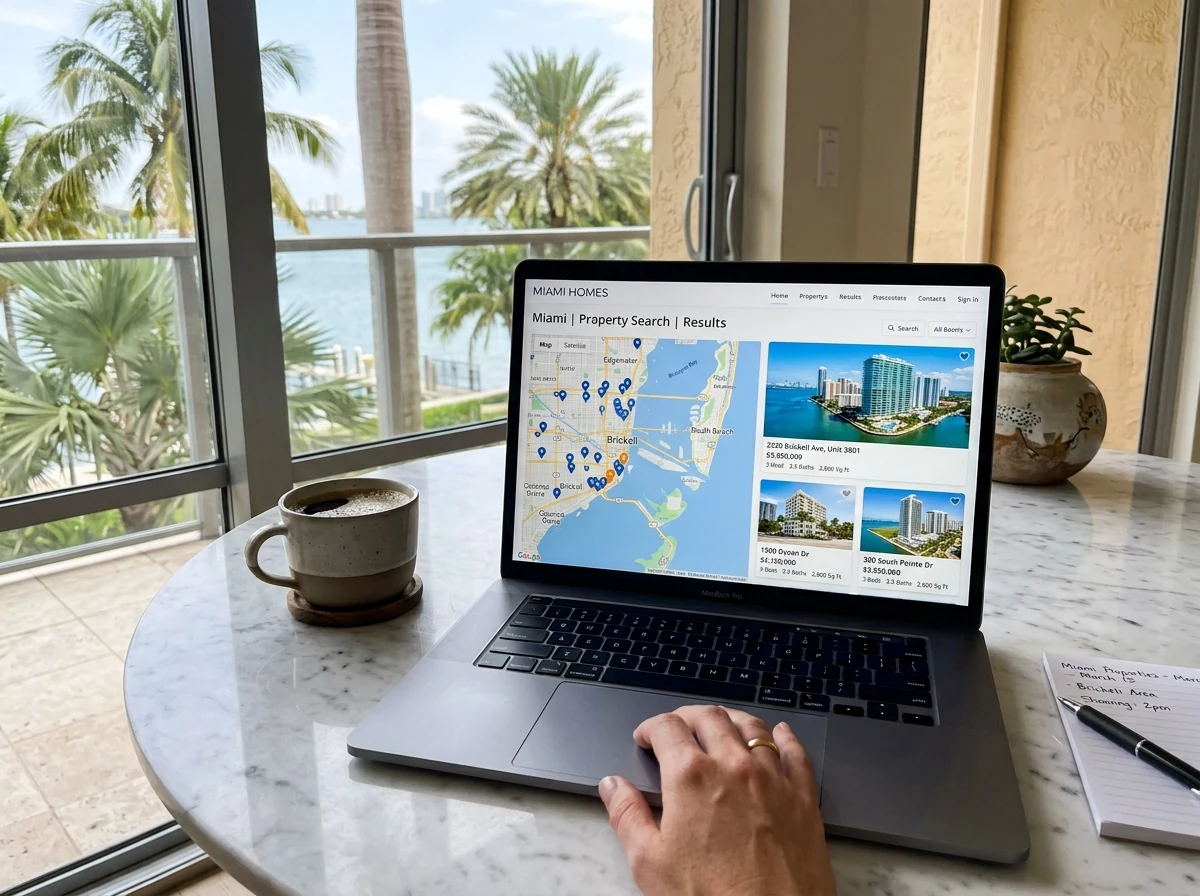
Neighborhood landing pages. One page per neighborhood you serve (Brickell, Coral Gables, Coconut Grove, Miami Beach, Bal Harbour, Sunny Isles, Aventura, Doral, Key Biscayne). Each page includes market stats, recent sales, current listings, a neighborhood story, and a specific lead capture. These are the SEO workhorse of any Miami real estate site.
A saved search feature. Buyers can save their filter criteria and receive email alerts when new listings match. This is the number one repeat-visit driver on real estate sites. Free to add. Massive ROI.
A property valuation tool for sellers. A simple form that estimates a home's value based on address, then follows up with a full CMA from the agent. Even a rough automated estimate captures seller leads at 4 to 8 times the rate of a generic contact form.
Agent pages with real content. Not a bio and a headshot. Recent sales with photos and neighborhoods, testimonials from actual clients, press mentions, community involvement, and a schedule-a-call button. This is the seller trust page.
A mortgage calculator on every listing detail page. Simple, immediate, saves buyers from bouncing to a third-party calculator and losing your site in the process.
Recent sales pages. Every closed listing becomes a "sold" page with the story, the photos, and the sale-versus-list price if you can share it. These pages rank well for "sold prices in neighborhood" queries that competitors ignore.
A press and awards section. Miami real estate is a trust game. If you have been in the Miami Herald, the Wall Street Journal, or a top-agent list, put it above the fold with logos.
A clear closing CTA on every page. Buyers get "browse current listings." Sellers get "get a home valuation." Both get a schedule-a-call button in the same visual spot on every page.
Lead Capture Patterns That Convert
Three patterns move the needle for Miami real estate sites specifically.
The first is progressive disclosure on lead forms. Do not ask for name, email, phone, budget, timeline, and neighborhood on the first form. Ask for one thing to open the door (email for saved search, address for valuation) and use the follow-up sequence to gather the rest. Single-field forms convert 3 to 5 times higher than five-field forms.
The second is neighborhood-specific lead magnets. A generic "get our newsletter" performs poorly. A "Brickell condo market report for July" or "Coral Gables 2026 buyer's guide" performs well because it names what the visitor already wants. Build one lead magnet per neighborhood you serve. Update quarterly.
The third is soft CTAs on listing detail pages. Instead of "contact agent," offer "get more photos" or "get the floor plan" or "request an in-person tour." These convert at 2 to 4 times the rate of generic contact CTAs because they ask for the specific next step the buyer is thinking about anyway.
Whatever forms you build, the leads must land in a CRM your team actually uses. Our CRM management service is where we set up the pipeline that turns web leads into scheduled showings.
The IDX Question
Every Miami real estate build eventually hits the IDX question. Which platform, which integration model, which price tier.
For most single agents and small teams, the practical choices are IDX Broker, Showcase IDX, Realtyna, iHomefinder, and a direct RETS or RESO Web API feed from the MLS. Each has trade-offs.
IDX Broker is the largest and most reliable. Their embedded widgets are ugly. Their newer API options are better but require developer work. Total cost with the developer work: about $2,000 to $4,000 setup, $50 to $150 monthly.
Showcase IDX has cleaner default design and is easier to skin. Setup runs $1,000 to $3,000, monthly $60 to $130. Fewer features on the search side.
Realtyna offers deeper customization but requires more technical work. Setup $2,500 to $6,000, monthly $80 to $200.
iHomefinder is the fastest path to a functional MLS search but has the most restrictive design. Setup $500 to $1,500, monthly $80 to $150.
A direct RETS or RESO feed with a custom-built search bypasses the SaaS layer entirely. Setup $8,000 to $20,000, monthly $40 to $100 (data fees only). This is the premium build path for teams that want full design control and are prepared for the maintenance overhead.
For Miami specifically, we default to Showcase IDX for solo agents on a tighter budget and direct RESO feeds for teams above $30 million in annual volume. Middle case, IDX Broker with the newer API integration.
Local SEO for Miami Real Estate
Real estate is one of the most competitive SEO verticals in Miami. Winning takes specific work.
Neighborhood landing pages are the primary asset. Each one needs 1,200 to 2,500 words, real market data, current listings, recent sold data, and a neighborhood story. Generic pages will not rank. Specific pages will.
Individual listing pages need schema markup (RealEstateListing schema type in JSON-LD), fast image loading, and clean URL structures. This is table stakes. Most Miami real estate sites still miss it.
A steady content publishing cadence helps. Two to four pieces per month, either neighborhood market updates, home buying guides, or seller advice tied to Miami specifically. Content on generic real estate topics competes with national sites and rarely wins.
Google Business Profile matters for individual agents and small teams. Register as a "Real Estate Agent" with the specific city as your service area. Photos, posts, reviews, and neighborhood-tagged content all move rankings. Our local SEO service covers this piece for real estate clients.
Reviews and referrals ride on the site's trust signals. Embed live Google reviews, showcase testimonials on agent pages, and include closing statistics if you can share them.
What Miami Real Estate Sites Should Skip
Three features owners often ask for and that rarely earn their keep.
Live chat with a human. Buyers do not want to chat with a bot about a $2.4 million listing. If chat matters, use a scheduled callback or a chatbot that captures contact info and hands off. Do not staff live chat at all hours.
Virtual tours embedded on every listing. If your listings actually have 3D tours, embed them. If they do not, do not build the infrastructure. Empty tour buttons hurt trust.
Complicated filtering. Buyers use price, beds, and neighborhood. Everything else (pool, waterfront, HOA fees, garage spaces) is a nice-to-have that rarely gets touched. Do not spend design cycles on filter UI nobody uses.
What the Numbers Look Like at Six Months
For the Brickell agent build referenced in the intro, six months after launch:
Organic traffic up 178 percent, mostly to neighborhood pages.
Lead volume up 92 percent, driven mostly by saved search signups and neighborhood-specific lead magnets.
Lead-to-showing conversion up 42 percent, driven by soft CTAs on listing detail pages.
Time on site up from 1:14 to 3:22 average, driven by the neighborhood story pages.
Return visitor rate up from 14 percent to 39 percent, driven by saved search email alerts pulling buyers back.
Not every Miami real estate build will hit these numbers. What we can say is that none of them would have happened with the previous template. If you want to see this pattern in practice, our portfolio has examples across the Miami market.
The One Thing to Do Tomorrow
Open your current site on your phone. Time yourself trying to find three recent listings in a specific Miami neighborhood. If it takes more than 20 seconds, buyers are not doing it either. That is your first fix.
When you are ready to run a real Miami real estate rebuild, start a project with us and we will scope it for your production volume, your target neighborhoods, and your existing CRM.