


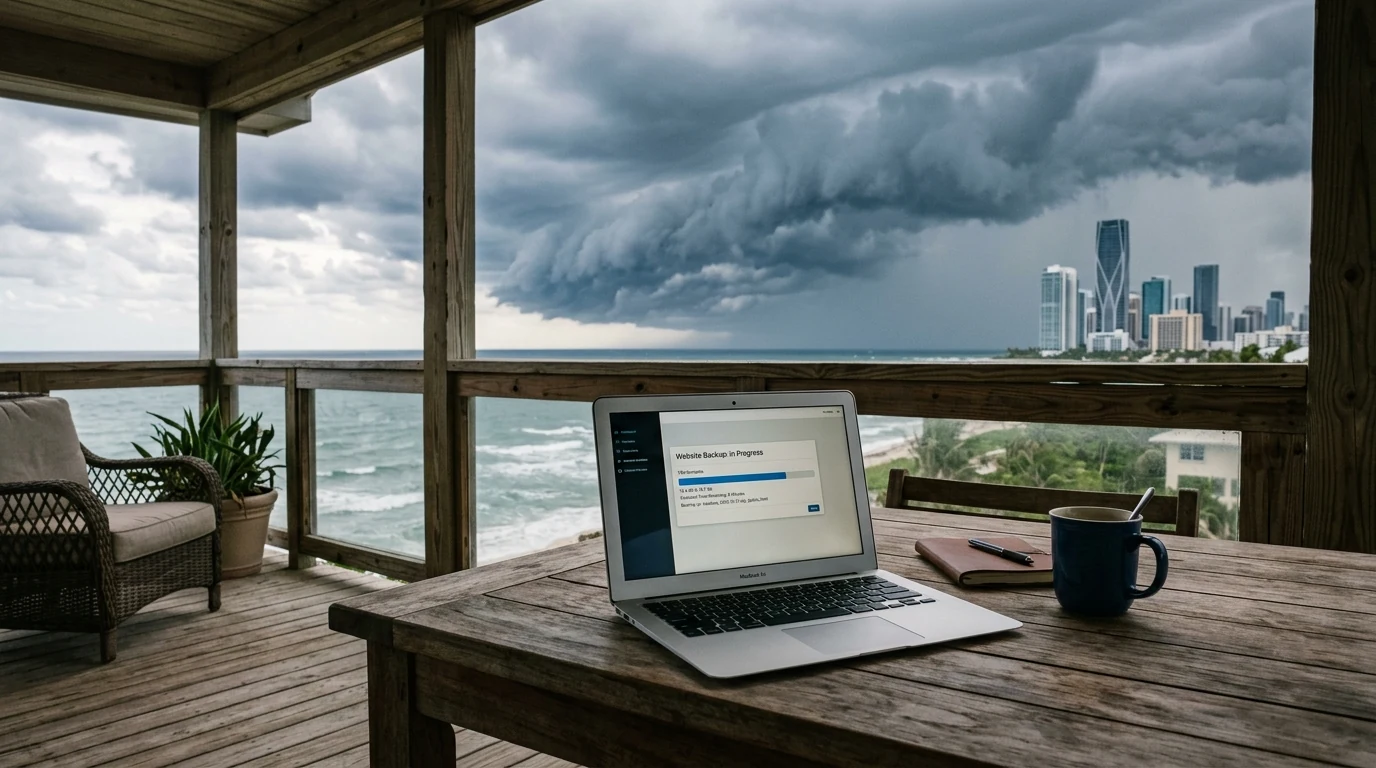
The Wynwood restaurant owner called us on a Wednesday morning in September. His website had been down since Monday night. He had not noticed until a regular emailed asking why the online ordering was broken. Two days of missed takeout orders. Rough estimate: $8,400 in lost revenue. The problem was a plugin update that had failed silently. The site had rolled back partway and then stalled. Nothing was on fire. Nobody was going to notice unless somebody was watching.
He was paying $18 a month for hosting and $0 for maintenance. He is now paying $340 a month for real maintenance and has not had an outage since. The math on that swap earned itself back in the first storm week.
This post is what real Miami website maintenance actually covers, why "set and forget" costs you more than you think, and how to budget for the ongoing work. If you want us handling this for you, our website maintenance service is where this lives.
A note on scope. This is written for Miami small businesses with live websites doing meaningful revenue. If your website is a static brochure that no customer transacts on, some of this matters less. If your website is where customers book, order, or pay, all of this matters a lot.

What "Set and Forget" Actually Costs
Most Miami small business owners think of their website as a one-time build cost. Once it is up, it should just work. The reality is different. Websites are living systems that decay quietly.
Software components update constantly. WordPress core, plugins, and themes ship security patches monthly. If they do not get applied, vulnerabilities accumulate. Third-party integrations change their APIs regularly. If your site connects to Mailchimp, Klaviyo, HubSpot, or a payment processor, those connections need periodic updates.
Content also decays. Business hours change during holidays. Menus rotate seasonally. Prices adjust. Team members come and go. A site that shows outdated information is worse than a site that shows nothing because customers act on what they see and get frustrated when reality does not match.
Performance decays too. Images accumulate. Databases grow. Old traffic patterns become new traffic patterns and pages that used to load in one second load in four.
Security threats evolve. Automated scanners hit small business websites thousands of times per month looking for known vulnerabilities. Sites that have not been updated in a year are the ones that get compromised. The average time from vulnerability disclosure to active exploitation is now under 72 hours.
For Miami specifically, hurricane season adds a layer. Sites hosted on shared hosting in Florida can slow or fail during storm weeks. Sites with proper CDN and backup strategies stay up when others do not.
The businesses that treat websites as living systems maintain them. The businesses that treat them as brochures find out the hard way when something breaks at the worst possible time.
What Monthly Maintenance Should Actually Cover
Ten specific tasks belong in every Miami small business website maintenance plan.
Software updates. WordPress core, plugins, themes, or platform updates depending on your stack. Applied within 48 hours of release. Tested on a staging site before pushed to production.
Security scanning and monitoring. Automated scans for known vulnerabilities. Malware monitoring. Uptime monitoring with alerts to you and your maintenance team.
Backups. Full site backups daily, retained for at least 30 days. Off-site storage (not on the same hosting account that could be compromised). Tested restores quarterly.
Performance monitoring. PageSpeed Insights or Lighthouse scores tracked monthly. Any regressions investigated and fixed. Image optimization on new uploads.
Broken link checks. Monthly scan for internal and external broken links. Fixed or removed.
Form testing. Contact forms, booking forms, and any other conversion-critical forms tested monthly to confirm submissions land where they should.
SSL and domain monitoring. SSL certificate renewals tracked and renewed. Domain expiration tracked. Nothing worse than losing a domain because a renewal notice went to an old email.
Analytics review. Monthly review of Google Analytics, Search Console, and any conversion tracking to catch changes worth acting on.
Content updates. Business hours (including holidays), team members, prices, and seasonal offerings kept current. Not a big project. Small ongoing hygiene.
Storage and database optimization. Quarterly cleanup of unused files, post revisions, spam comments, and expired transients.
For most Miami small businesses, all ten tasks add up to 3 to 6 hours of skilled work per month. That is why real maintenance retainers run $150 to $500 monthly. Cheaper plans are either using unskilled labor or skipping steps.
What Cheap Maintenance Skips
A $30 monthly "maintenance plan" from a hosting provider or a low-touch agency typically covers software updates and backups. That is it. The other eight items on the list above are not included.
This works right up until the moment it does not. The Wynwood restaurant we opened this post with had cheap maintenance. Software updates happened. Backups happened. But nobody was monitoring uptime. Nobody was testing after the update. Nobody was watching for the plugin conflict that broke the site.
Real maintenance is not about applying updates. It is about someone who understands your specific site paying attention to it monthly. That is the value you pay for and that is what cheap plans skip.
The Miami Hurricane Season Consideration
Every Miami business with a website needs a hurricane season plan for the site. Not a marketing plan. An operational plan.
Backups need to be off-site and off-Florida. If your hosting provider's Florida data center is affected, your site should be restorable from a backup stored elsewhere. Most cheap maintenance plans back up to the same hosting account, which does nothing when that account is inaccessible.
Failover strategy. High-value sites should have a static failover version that goes live if the main site is inaccessible. Even a simple "we are experiencing temporary difficulties, please call us at phone" page saved offline and ready to deploy prevents the total blackout that harms customer trust.
Communication templates. Pre-written social media posts, email templates, and website banners for storm situations. Prepared before the storm, deployed within an hour when needed.
Team readiness. Your maintenance team should know the plan and know how to execute it without waking you at 3 a.m. This is the piece most Miami businesses skip. If your only person who can fix the site is out of town or without power, your site is down until they return.
None of this is expensive. It is a few hours of setup and a documented playbook. It saves your revenue in the weeks that matter most.

How to Budget for Maintenance
Reasonable ranges for Miami small business website maintenance in 2026.
$50 to $100 monthly: only basic software updates and backups. Fine for a static brochure site with no revenue depending on it. Not enough for anything you rely on.
$150 to $300 monthly: real maintenance including all ten tasks above. Skilled hands. Monthly report. Appropriate for most small business marketing sites with basic ecommerce or booking flows.
$300 to $700 monthly: full maintenance plus small content updates each month, priority response, and dedicated maintenance team assigned. Appropriate for revenue-critical sites, ecommerce stores, and multi-location businesses.
$700 plus monthly: enterprise support, dedicated account management, sub-hour response times, and coverage for complex integrations. Appropriate for larger operations.
The right budget for your business depends on how much revenue flows through the site. A rough guide: allocate 2 to 5 percent of the annual revenue that moves through the site to ongoing maintenance. A restaurant doing $60,000 monthly in online orders should not be paying $18 a month for hosting and calling that maintenance.
What Maintenance Is Not
A few common misunderstandings.
Maintenance is not redesigning the site. Small content updates yes. Major layout changes, new pages, new features are project work. Budget separately.
Maintenance is not free hosting. Some maintenance plans include hosting. Others require you to pay hosting separately. Both are fine. Just know which one you are buying.
Maintenance is not marketing. Adding a new blog post is not maintenance. Publishing content is a separate line item. Do not expect your maintenance team to write your marketing.
Maintenance is not custom development. Building new features, integrations, or major functionality is project work, not maintenance. Get quoted separately.
Making this clear upfront prevents scope arguments six months in.
When to Redesign Instead of Maintain
Some sites are past the point where maintenance keeps them viable. Three signals tell you it is time.
The site is more than four years old and running on a stack that is hard to maintain. WordPress with outdated plugins that no longer receive updates, custom PHP that was written by a developer who is unreachable, or a page builder that has been deprecated all fall into this category.
Performance is bad enough that maintenance cannot fix it. If the site loads in more than four seconds and no reasonable maintenance effort can improve that, a redesign is cheaper than fighting the old site every month.
Business requirements have changed. A restaurant that now offers catering. A service business that now operates in three cities. A shop that has moved into ecommerce. These are redesign projects, not maintenance items.
If you are in this territory, our website redesign service usually pays for itself faster than paying for expensive maintenance on a site that keeps breaking. You can see examples in our portfolio.
The One Thing to Do Tomorrow
Open your last three months of website hosting and maintenance invoices. Add them up. Now ask yourself if you know, specifically, what work was done on your site in each of those months. If the answer is not clear, either the work is not happening or you are not being told about it. Either way, that is the problem to fix.
When you are ready to run real Miami website maintenance, start a project with us and we will scope a plan for your specific stack, your revenue exposure, and your hurricane season risk profile.